The Best First Foods for Babies: Safe, Simple & Pediatrician-Approved

Starting solids can feel like a big deal. One minute you have a milk-only baby, and the next you are being told to mash avocados and brace for banana eyebrows.
So if you are standing in the baby aisle wondering if you need a PhD to feed your kid, let me make this easy for you: you don’t. You just need a few basic tips, a bib or 10, and maybe a sense of humor.
When Can My Baby Start Solids?
Most pediatricians and child development experts recommend starting solids around 6 months, when your baby is showing signs of readiness. As always, check with your child’s pediatrician if you are unsure or if your baby has specific medical or feeding concerns.
Some signs your baby may be ready include:
Good head and neck control
Sitting up with support
Showing interest in your food
Opening their mouth when food is offered
Losing the tongue-thrust reflex, so food does not automatically get pushed back out
Basically, if your baby is watching every bite you take like they are deeply offended they were not invited, it may be time to start the conversation.
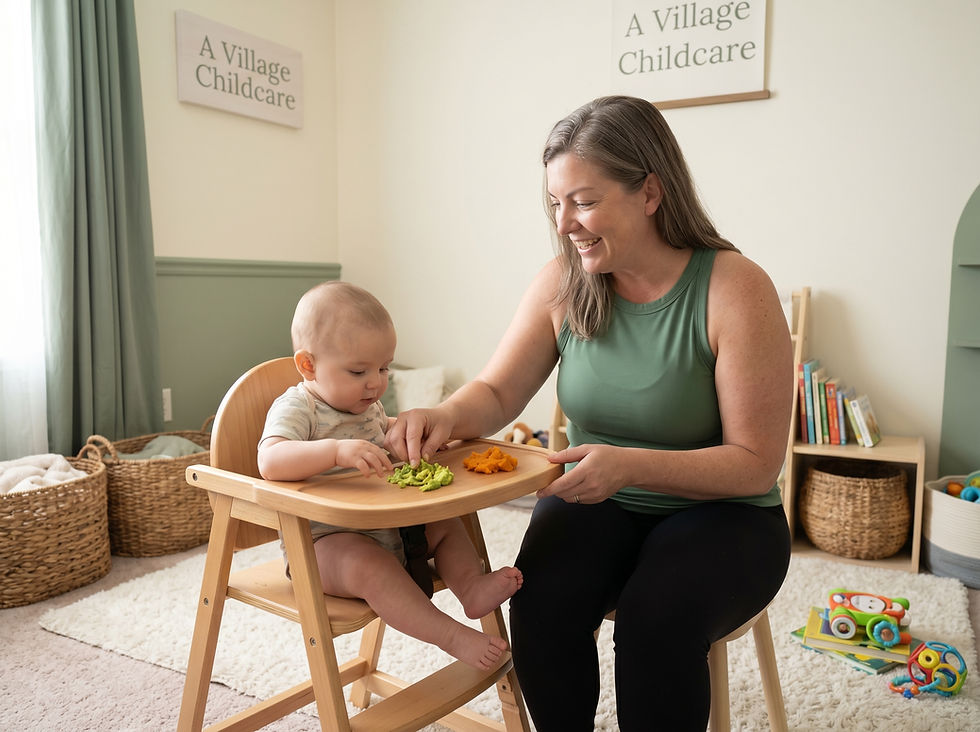
Do I Need to Do Purees or Baby-Led Weaning?
Short answer? You can do either. Or both.
It is not a cult. It is just food.
Whether you are spooning mashed peas or offering a soft piece of sweet potato for your baby to explore, the goal is the same: helping your baby learn to chew, swallow, explore textures, and enjoy food at their own pace.
At A Village Childcare, we use a practical blend of approaches. We offer soft, age-appropriate foods babies can explore, along with simple spoon-fed options when needed. The goal is not to make feeding complicated. The goal is to help babies build confidence and skill safely.
Best First Foods (Backed by Pediatricians & Real-Life Experience)
Here’s a short list of nutrient-rich, allergy-conscious foods that are perfect for beginners:
✅ Mashed avocado – healthy fats, soft texture, no prep beyond cutting
✅ Bananas – sweet, mashable, and travel well in a diaper bag
✅ Cooked sweet potato – loaded with vitamins and easy to hold
✅ Soft scrambled egg yolks – great for iron and brain development
✅ Oatmeal – iron-fortified and easy to mix with breast milk or formula
✅ Full-fat plain yogurt – probiotics and creamy goodness
✅ Steamed broccoli florets – a favorite for baby-led weaners!
✅ Soft ripe pear or peach slices – peeled and juicy
✅ Peanut butter (thinned) – now recommended early to reduce allergy risk
✅ Ground meats – like turkey or beef, mixed with broth or mashed veggies
The exact order is not the most important part. What matters most is offering safe textures, watching your baby closely, and introducing foods in a way that works for your child.
What Foods Should I Avoid at First?
There are a few foods babies should avoid during the first year or until they can safely manage them:
Honey before age 1
Choking hazards like whole grapes, nuts, popcorn, raw carrots, and hot dogs cut into rounds
Cow’s milk as a drink before age 1
Foods with lots of added sugar or salt
Foods with artificial dyes, which we avoid here
Some foods can still be used safely in different forms. For example, cow’s milk is not recommended as a drink before age 1, but small amounts of dairy foods like yogurt may be appropriate for many babies. This is another reason it helps to check with your pediatrician if you are unsure.
Tips from the Daycare Trenches
Dress baby like you would dress for finger painting. This is not a tidy process, and that is okay.
Let them play with their food. Messy eating helps babies learn about texture, taste, smell, and control. It may look like chaos, but a lot of learning is happening.
Offer one new food at a time when needed, especially for common allergens or if your child has a history of reactions. This can make it easier to notice what caused a problem.
Do not panic if they make “yuck” faces. That is just the baby version of Yelp. Keep offering. Babies often need repeated exposure before they accept a new food.
Real Talk: Every Baby Is Different
Some babies dive face-first into yogurt like it is their life’s calling. Others will side-eye a spoon for three weeks like you have personally betrayed them.
Both can be normal.
The key is low pressure, safe foods, repeated exposure, and lots of patience. Starting solids is not about creating a perfect eater overnight. It is about helping your baby explore food in a safe, positive way.
Need Help Planning Baby Meals?
At A Village Childcare, we provide CACFP-approved meals for all ages, including babies who are starting solids. Our menus focus on whole foods, balanced nutrition, and age-appropriate textures that help children build healthy habits from the very first bite.
We know feeding babies can feel overwhelming at first, but it does not have to be complicated. With patience, safe foods, and a little flexibility, babies can learn to enjoy food one tiny messy bite at a time.

💬 Ready to Learn More?
We’d love to welcome your child into our village.
📞 Text us 317‑910‑4227 or click below and fill out the form
📝 Check out our FAQ page for more info!


Comments